

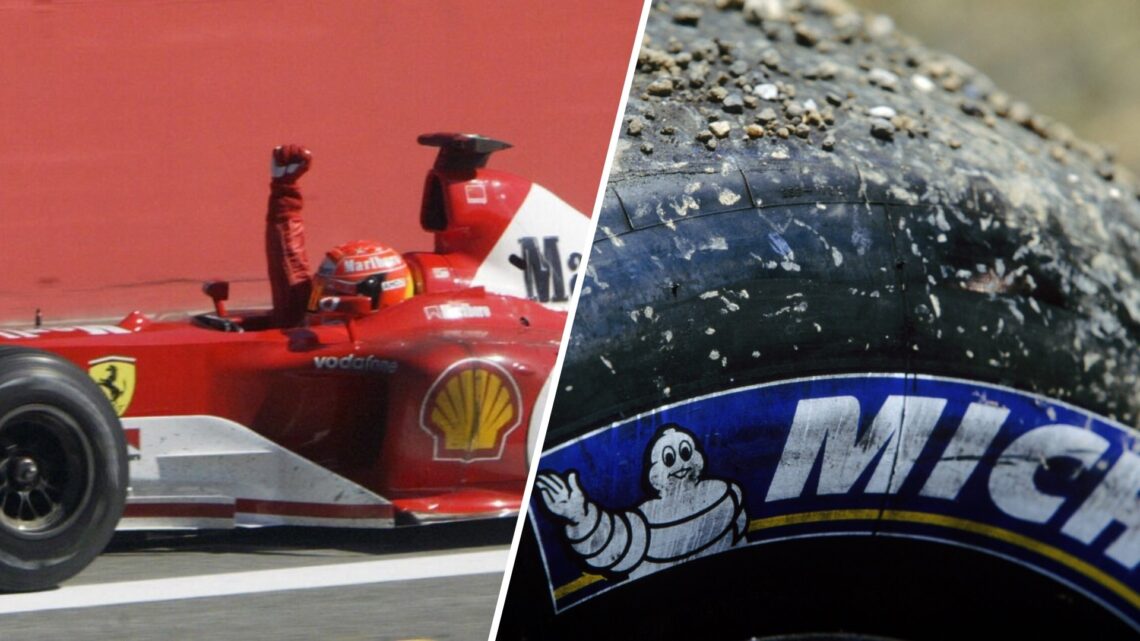


Ferrari’s run of dominance with Michael Schumacher was unprecedented, with the team winning five Drivers and Constructors’ Championships in a row.
Even though it took Schumacher four years before he found success at Maranello, he would go on a record run of wins that would stand for another 15 years before being broken.
Ferrari’s early 2000 season saw them battle with McLaren and Mika Hakkinen, but when the Finn decided to take a sabbatical at the end of 2001, they were largely left unchallenged in 2002.
Things changed in 2003 when a thrilling chase for the championship started to form between Schumacher, Kimi Raikkonen, Juan Pablo Montoya and Ralf Schumacher.
But it would all come to a premature end when Ferrari and tyre supplier Bridgestone protested their rivals and even came close to getting them disqualified at the 2003 Italian Grand Prix.
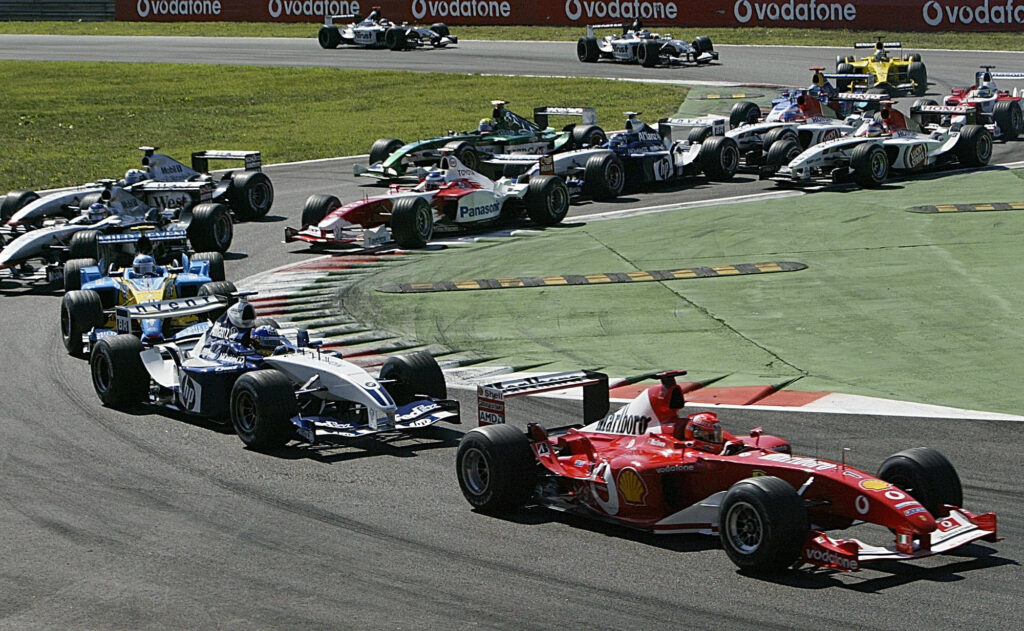
Ferrari and Bridgestone protest Michelin tyre runners
Back in 2003, F1 had two tyre suppliers: Michelin and Bridgestone. Williams and McLaren were running the Michelin tyres, while Ferrari ran Bridgestones.
At the heart of the controversy was a protest initiated by Bridgestone and supported by Ferrari, who claimed that Michelin’s tyres were deforming beyond the maximum tread width during the race, creating a larger contact patch with the tarmac and giving their drivers more grip.
The FIA only measured the tread width before the races rather than after, but after Bridgestone was able to provide photographic evidence that the tyres were going beyond the legally allowed limit, Charlie Whiting issued a letter to all teams to say that tyres would now be checked before and after the races.
He also stated that any part of the tyres that were in regular or systematic contact to the track would be considered tread and taken into account when measuring the width of the tyre. It led to a fallout between the teams and even the threat of legal action against Ferrari’s Ross Brawn from Michelin.
READ MORE: When Kimi Raikkonen was handed an F1 win ‘by mistake’ after ‘crazy’ 2003 Brazilian Grand Prix
Ted Kravitz recalls seeing ‘extreme’ Michelin tyres in the pit lane
Proving that Michelin were manipulating the tyre tread to provide better grip levels was tricky, because it would be impossible to know unless you saw it happening out on track at 200mph.
By the time the cars pulled into Parc Ferme at the end of a race, they had already picked up excess rubber to help with the overall car weight, concealing any potential advantage.
However, pit reporter Ted Kravitz claimed he spotted the trick being used by Michelin whenever cars pulled into the pits when speaking on the Bring Back V10s podcast.
“I’d seen this in the pits. I’m not sure it really took a Bridgestone photograph to show this, because you can even see it when they came back in, I could sometimes see it when the tyres came off at pit stops,” said Kravitz.
“The Michelin tyre had a way of slightly flattening out. Even an extreme version, there’d be the tiniest little lip of rubber over the top corner of the tread. And then it would come round into the sidewall.
“That was the way the Michelins were constructed; it would sort of flatten out and spread out. I always thought when I looked at them: ‘Oh, that’s quite clever. I wonder if it gives them a bit of a bigger contact patch on the tread, or maybe it’s a soft bit of rubber. Maybe it’s just that the rubber degrades.’
“Whereas the Bridgestone tyre was always a little bit more oval at the top. It was like the wide part of an egg.”
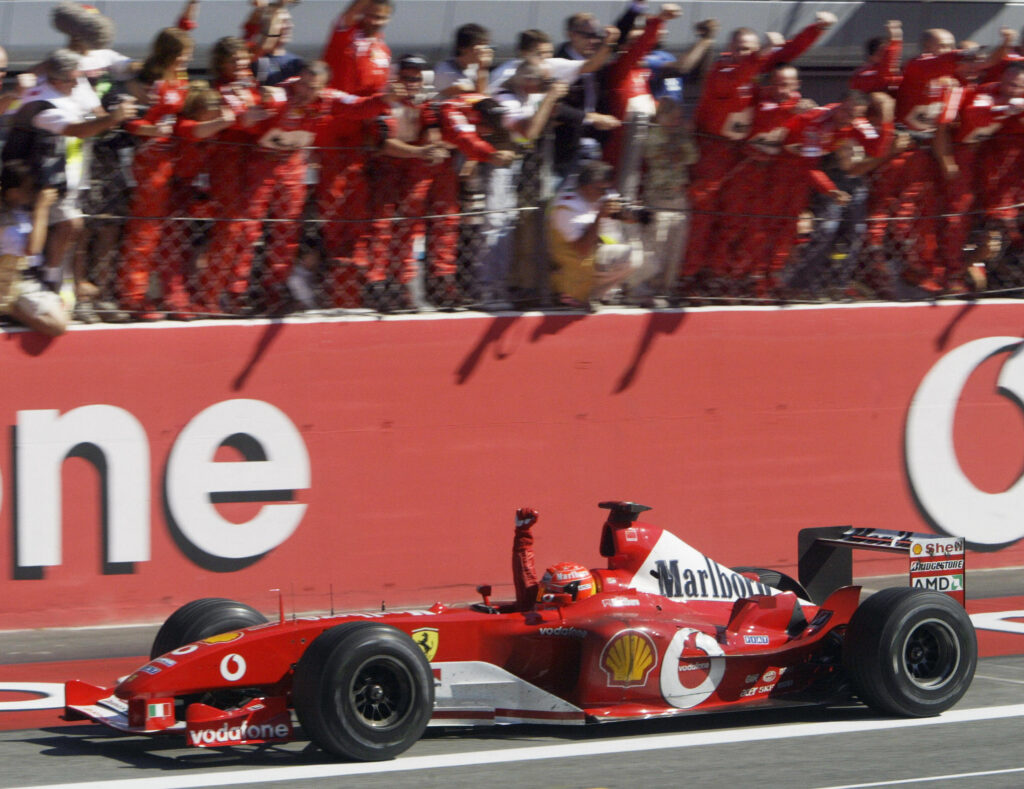
FIA accused of favouring Ferrari
The FIA revised the rule for the 14th round of the season at the Italian Grand Prix in Monza, although not without apprehension from Michelin, who felt the turnaround was too quick and claimed teams who ran their tyres would be willing to be disqualified.
The governing body was also accused of favouring Ferrari, which is what led some to brand the FIA as ‘Ferrari International Assistance’, but addressing the element of favouritism in his book, former FIA President Max Mosley felt it was almost impossible to convince fans with an affiliation to a certain team of its impartiality.
“However hard you try to be even-handed between all participants, I don’t think it will ever be possible to convince the most committed Formula 1 fan that the system is fair if a decision is taken which is perceived as disadvantageous to their favourite team,” wrote Mosley in his book Formula One and Beyond.
Questions were asked over why Ferrari and Bridgestone took so long to raise the issue with the FIA, given they were aware of the specification of tyres since Imola in 2001. Conspirators believe they were sitting on the information and deployed it after experiencing a difficult second half to the 2003 season.
The reality is, Bridgestone didn’t have concrete evidence or the political acumen within its team to raise the issue properly with the FIA. Both Ross Brawn and Jean Todt took the case and fought in the interests of Ferrari, with it ultimately yielding Schumacher’s third title in a row at the end of 2003.