

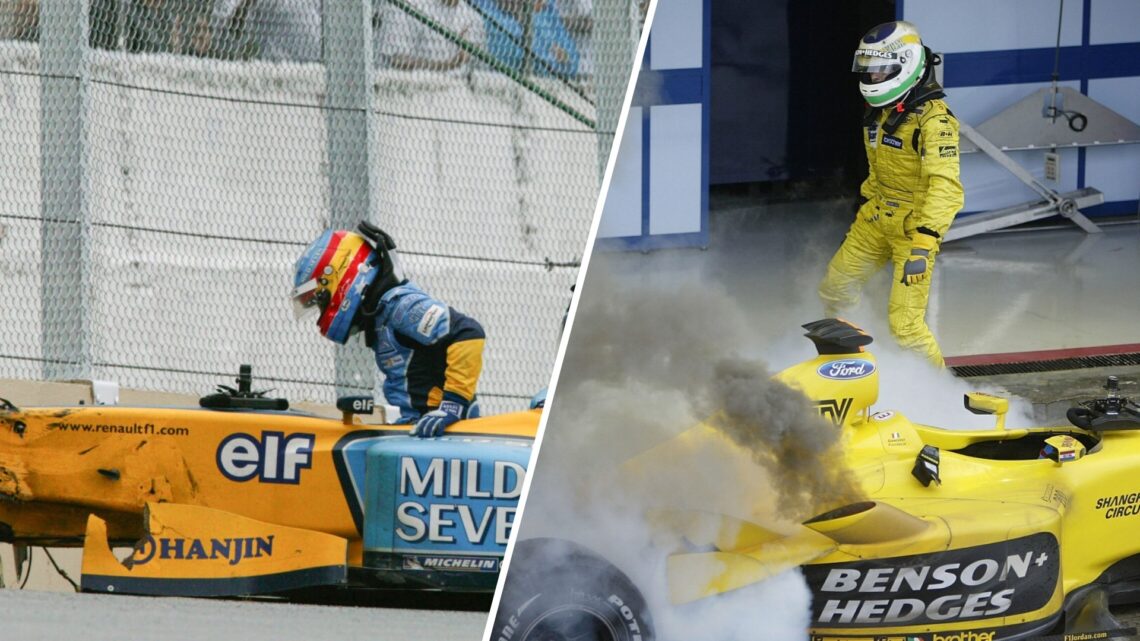


They always say rain is the great equaliser in F1, and the third round of the 2003 Formula 1 season was a true example of this in the sodden conditions at Sao Paulo.
Rain had hit the track in the minutes before the race started, and after a few delays, the cars got underway under Safety Car.
F1 had a tricky relationship with rain delays in previous years, and Safety Car starts had only just started to become common in poor conditions after the scary crash at the start of the 1998 Belgian Grand Prix.
Ferrari’s Rubens Barrichello led the field away from the McLaren of David Coulthard and Jaguar’s Mark Webber. Reigning world champion Michael Schumacher was in seventh place ahead of Giancarlo Fisichella, who was hoping to nab points for Jordan after a difficult start to the year for them.
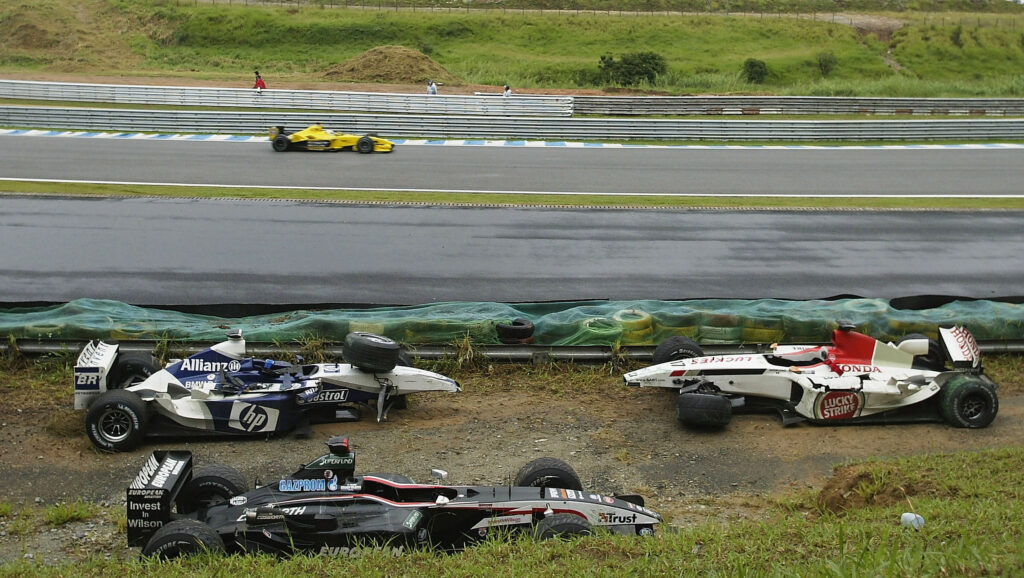
Start of the 2003 Brazilian Grand Prix marred by crashes
A number of drivers were caught out by the poor conditions at Turn 3, which effectively had a river of water running through it before the circuit upgraded its draining facilities.
Schumacher was caught out by the conditions, as was Jenson Button, Juan Pablo Montoya, and Jos Verstappen who all smashed into the barriers on the outside of the corner.
“Brazil 2003 was a crazy race. It was a difficult race because it was raining, it was really wet, a lot of accidents and mistakes by the drivers but I’ve been able to keep the car on the ground,” said Fisichella when speaking to F1 Clash.
Barrichello was leading by this point and hopeful of breaking his home race curse, but he would also retire from the race with a mechanical problem in his Ferrari. This handed the lead to Coulthard from teammate Kimi Raikkonen and Fisichella.
An early pit stop for fuel had enabled Fisichella to run longer into the race and adapt their strategy to wet conditions. Coulthard had to pit on Lap 52, and it enabled Fisichella to challenge Raikkonen for the lead, with the Italian pressuring him into a mistake at Mergulho.
READ MORE: When Jackie Stewart won his third Formula 1 title after an Emerson Fittipaldi team orders dispute
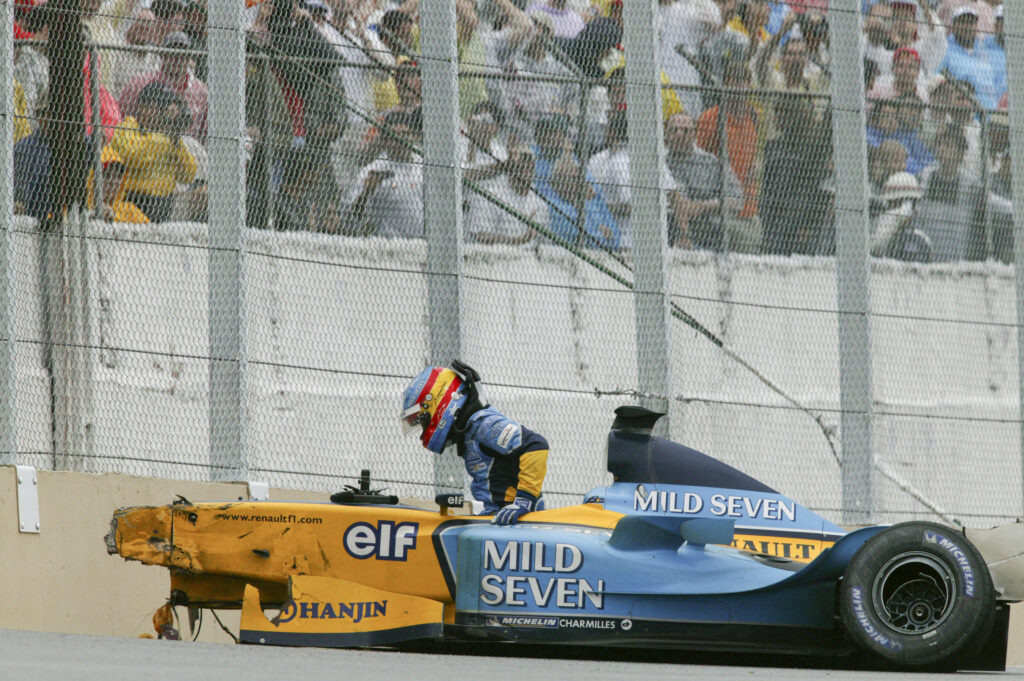
Fernando Alonso suffers terrifying crash at 180mph
Fisichella held onto the lead for a few moments before the red flag came out after a massive crash for Fernando Alonso and Mark Webber.
Webber had lost control of his Jaguar while accelerating on the Arquibancadas corner, colliding with the outside wall and slamming into the tyre barriers.
This was in the days before TecPro barriers and other safer solutions, so the belt of tyres had separated due to the impact and scattered across the track. A few cars darted out of the way to avoid but Alonso came unsighted on the uphill corner and slammed into one, colliding with the concrete barrier and coming to a rest on the opposite side of Webber’s car.
By this stage, it looked like a bomb had gone off with all the debris scattered across the track, and the red flag had emerged. A winded Alonso clambered out of his car, sat down, and rested his back against the barriers.
The FIA medical team arrived to treat Alonso, with the chief medical officer, Gary Hartstein, recalling how it happened on his blog, FormerF1Doc: “When we arrived on-scene, Fernando was half sitting, leaning back against the base of the grandstand wall. He was pale, sweaty, and clearly not in top form. I’d seen the accident on the screens in the Medical Car, and knew it had been huge.
“I told Fernando that we were going to place him on a gurney, load him onto the ambulance that had already arrived on-scene. ‘I’m not going on a stretcher, I’m going to stand up’ he said stubbornly. I was annoyed, but not surprised. This is how these guys are. I thought about it for a moment.”
With the help of the local doctor, Hartstein would allow Alonso to wave to the crowd before placing the Spaniard on a gurney and loading him into the ambulance to be taken to the medical centre. He would later be released after precautionary checks with no injuries.
Kimi Raikkonen mistakenly named the winner of 2003 Brazilian Grand Prix
The red flag after 75% distance had been completed meant the race would not resume, with the results being taken two laps prior to the red flags being shown.
Jordan and Fisichella thought they had won the race, and as he entered Parc Ferme, they began to celebrate their fourth Grand Prix victory. Or so they thought…
News began to filter that Raikkonen was declared the winner of the race, as the stewards believed Fisichella was on Lap 55 when the red flag conditions began and applied the countback rule to declare the result of the race from Lap 53 when Raikkonen was leading.
To add to the drama, Fisichella’s car had caught fire in the Parc Ferme area due to an engine issue that had developed during the slow in-lap.
“By mistake, they gave me the first place to Kimi Raikkonen,” recalled Fisichella.
“We did an appeal, and after one week they understood the mistakes and they gave me back the victory. So the race after in Imola they gave me back the trophy and I was the winner of the race.”
Although Fisichella had to take to the podium and receive the second-placed trophy, Jordan had successfully argued that the timekeepers had gone back a lap further than they should’ve on the timing programme.
At the following race in Imola, Fisichella and Jordan were declared the winners just under 14 days after the confusing Sunday. It was an inaugural victory for the Italian and would become Jordan’s last in the F1 spotlight on the occasion of their 200th race before a final podium at the 2005 US Grand Prix – the same year it was sold.