

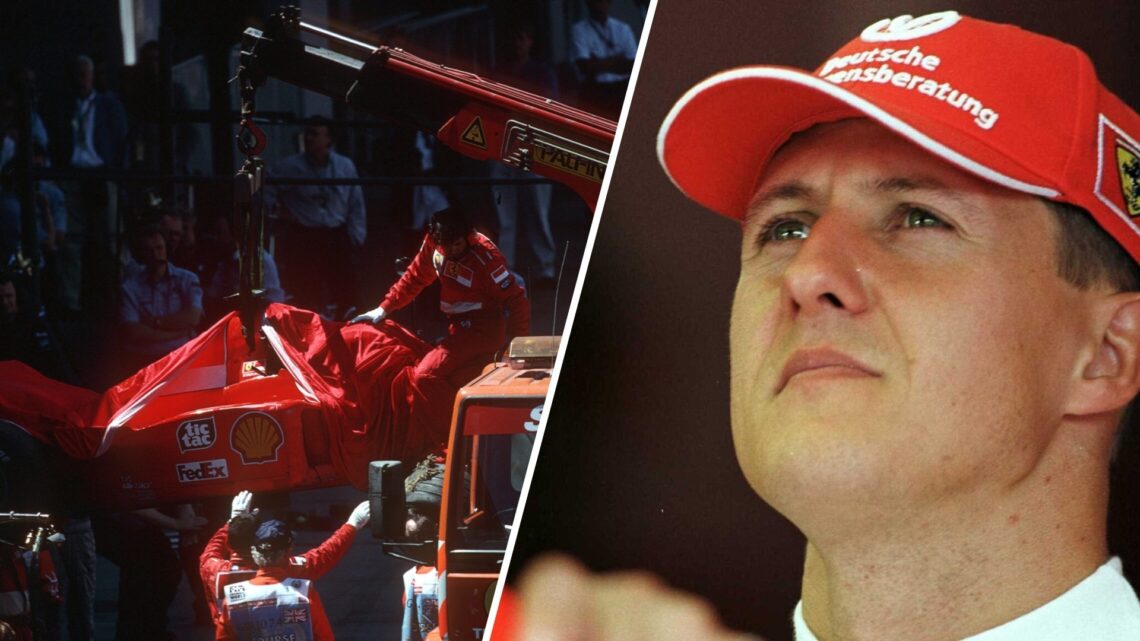

Ferrari were a dominant force in Formula 1 between the 2000 and 2004 seasons with Michael Schumacher, but it wasn’t always straightforward for the Italian team.
Schumacher had signed for Ferrari in 1996 and was tasked with bringing success back to Maranello, after its longest title drought since the 1970s.
Between 1990 and 1995, the team won only two races with Jean Alesi and Gerhard Berger. The need for change was evident, and Schumacher’s success at Benetton along with Ross Brawn caught the eye of Maranello.
Together with Jean Todt they assembled one of F1’s super teams, with Schumacher driving, Ross Brawn overseeing technical, and Rory Byrne designing the cars.
Schumacher’s first win came just a few races into the 1996 season in the wet at the Circuit de Barcelona Catalunya, and in 1997, he was on the cusp of title success before a controversial crash with Jacques Villeneuve at Jerez led to the FIA disqualifying him from the championship.
McLaren’s Mika Hakkinen would be unstoppable in 1998, and then in 1999, Ferrari came close again but doubts were starting to creep in over whether Schumacher was the right man for the job.
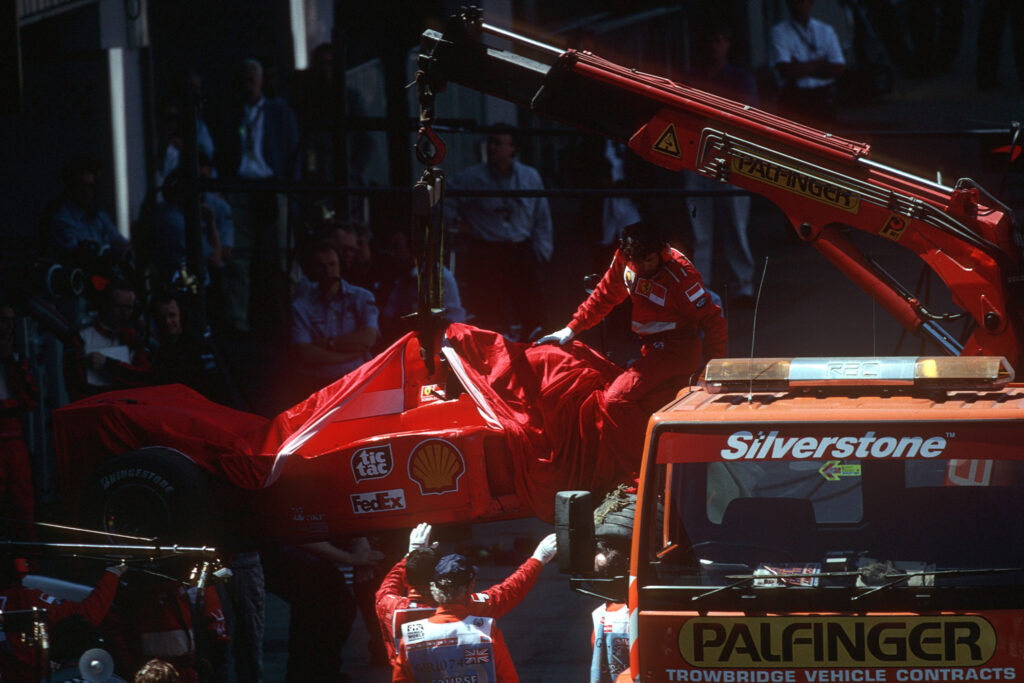
Ferrari doubted whether Michael Schumacher would bring title success after 1999 crash
Schumacher had already proven himself to be capable of winning titles, but had yet to do so for another team on the grid.
Ferrari was close in 1999 with McLaren, and by the eighth round of the season at Silverstone, Schumacher moved to within 10 points of Hakkinen.
The pair locked out the front row, but Schumacher had a bad start and dropped behind teammate Eddie Irvine. When they came up to Stowe corner, the German misjudged his braking and crashed into the barriers at high speed.
With his car buried into the tyre barrier, it took a while before he was extricated and eventually transported to the hospital, where he was deemed to have broken his leg. The incident would put him out for the next six races, getting replaced by Mika Salo, and led to doubts from Piero Ferrari.
“He knew that he was a winner, that he was a world champion. We were sure we were close, but we hadn’t won a world championship. When that happens, there is always doubts,” said Ferrari in the documentary, Schumacher.
Todt was also wondering if the team should pursue his main rival instead at the end of 1999: “He arrives in 1996, then ’97, ’98, ’99 [happen]. And at some point, one wonders if Michael is the driver for us or if we should have someone like Hakkinen.”
Ferrari’s 2000 season starts to unravel midway through the year
Ferrari sticks with Schumacher for the 2000 season and it appeared to be the correct decision when they won the first three races of the season.
Another win for Schumacher at the Nurburgring put him nearly 20 points ahead of Hakkinen in the title battle, but things would swing in the Finns favour at the midway point.
Between the five-race stretch of Monaco, Canada, France, Austria and Germany, Schumacher only scored 10 points with a win in Montreal after retiring from the other four. Hakkinen moved ahead by the Hungarian GP by two points, and more questions began to be asked over whether Schumacher could do it.
“First part of 2000 and things weren’t going the way we wanted. And suddenly, we found ourselves in the middle of the season, at a point where it was difficult to believe we could win,” said Todt.
“So we were questioning the qualities of the whole team and Michael’s as well. We now had to win every race. Because if we didn’t, we wouldn’t become world champions.”
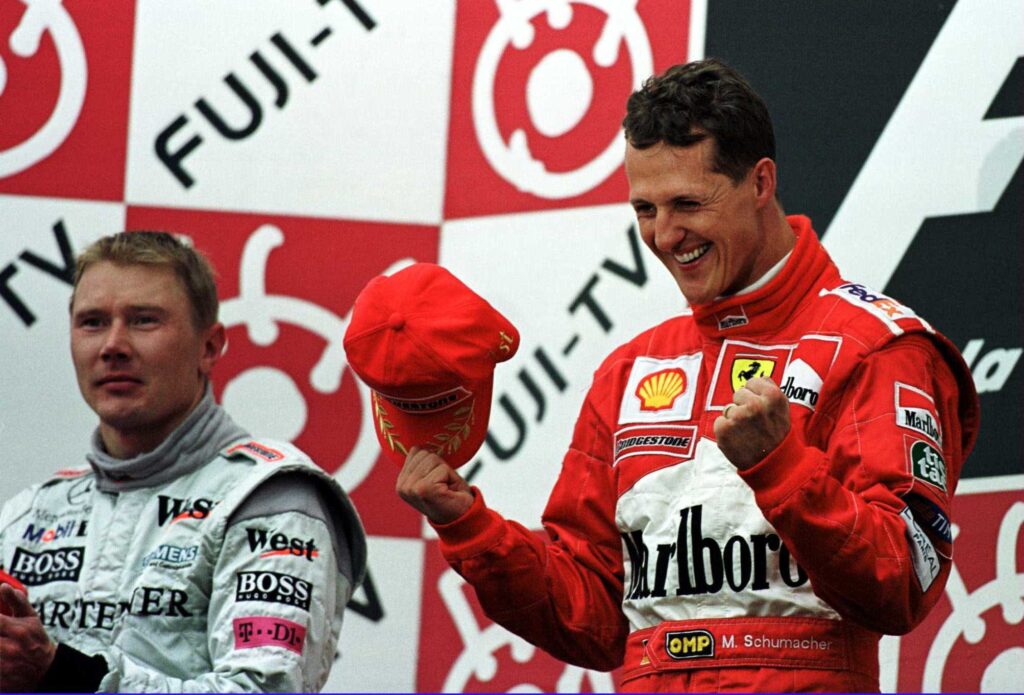
Michael Schumacher wins Ferrari’s first F1 title since 1979
After two second-placed finishes in Hungary and Belgium, Schumacher won the Italian and United States Grands Prix and put himself within touching distance at the Japanese GP.
Schumacher qualified on pole and led from Hakkinen for most of the race, with rain threatening most of the afternoon. As it began to intensify in the final laps, both teams started to question if it was right to stay out.
The German maintained the lead over Hakkinen and, with it, took his eighth race win of the season and secured his third title with Ferrari.
He became Maranello’s first world champion since Jody Scheckter in 1979, with Ferrari President Luca di Montezemolo branding Schumacher’s title victory the “most beautiful day of my life” in the media [via Atlas F1].