

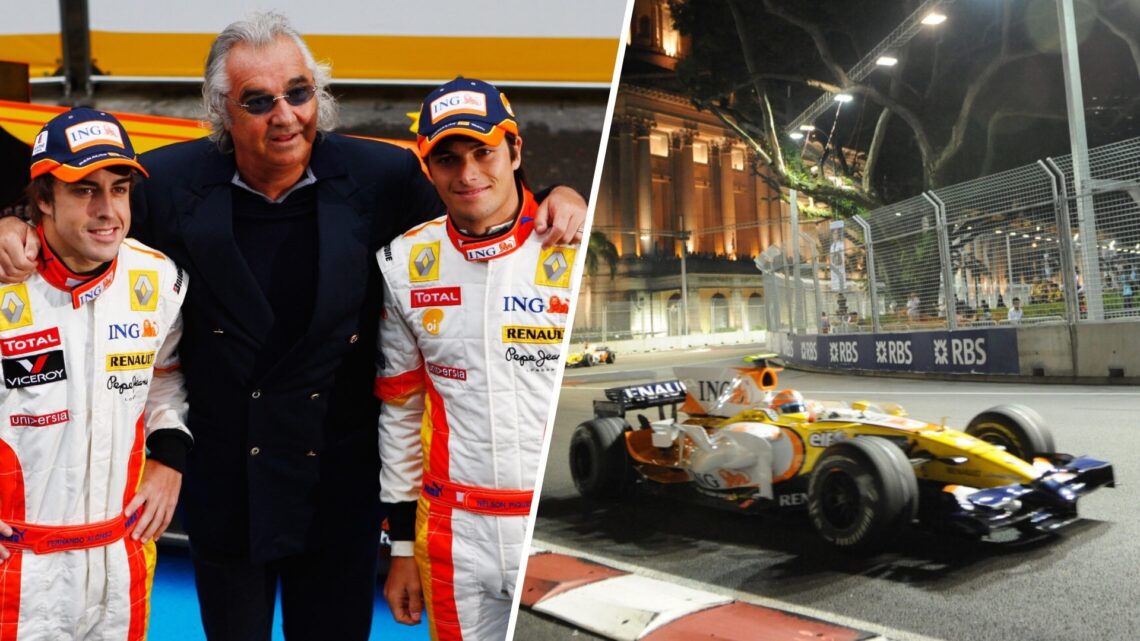

It’s been nearly 20 years since Crashgate took place at the 2008 Singapore Grand Prix, one of the biggest scandals in Formula 1 history.
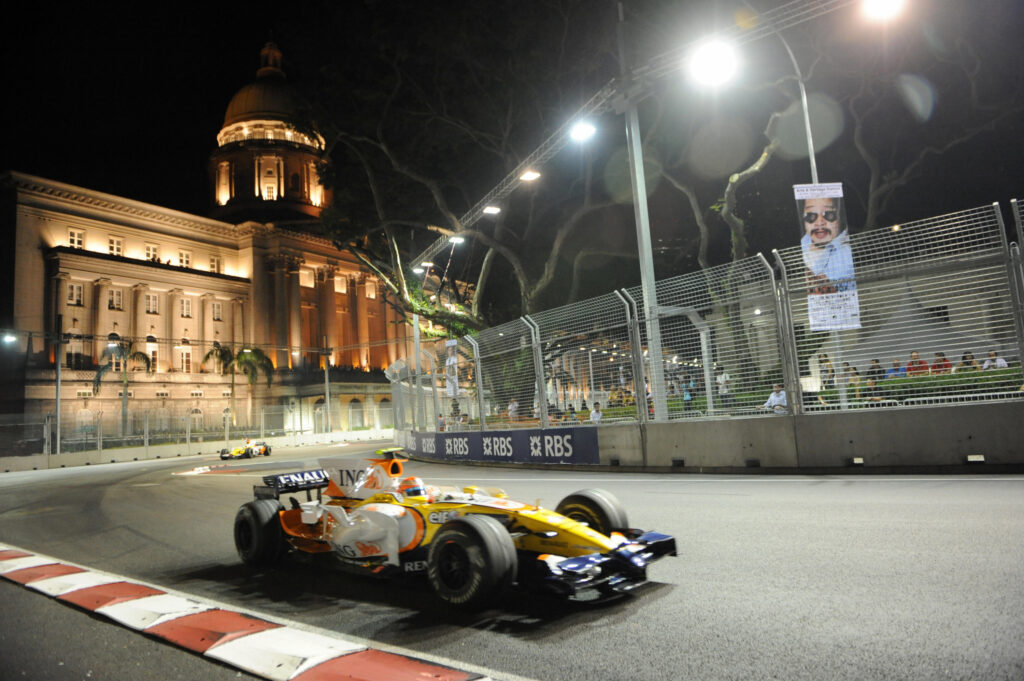
Nelson Piquet Jr was told to deliberately crash his Renault, which he did by driving into the wall at Turn 17 just 14 laps into the race, to create an opportunity for teammate Fernando Alonso to win the race.
The crash took place at a point on the street track which required Safety Car intervention for recovery and gave Alonso, who was mysteriously under-fueled and pitted earlier than anyone else, the perfect opportunity to leapfrog those ahead of him.
Post-race data showed that Piquet Jr had accelerated hard out of the corner and kept the throttle buried, while footage from the formation lap also appeared to have him rehearsing the move.
Alonso went on to win Renault’s only race in 2008, but it wasn’t until 12 months later that it came to light that it was all a fix.
How did Crashgate come to light?
Piquet Jr’s father, three-time world champion Nelson Piquet, had revealed to the FIA that conversations between the Renault team bosses Flavio Briatore and Pat Symonds occurred regarding the crash, which prompted the inquiry.
At the time, Piquet Jr’s seat was under threat following a tough start to the 2009 season and Renault accused him of false allegations and blackmail in attempt to secure his seat for the rest of the season.
During the FIA inquiry, Piquet Jr’s statement detailed that he was asked personally in the presence of Briatore and Symonds to “sacrifice his race for the team by causing a safety car” and to do so at a specific area of the track where there was no crane access.
Both Briatore and Symonds denied that the conversations took place, but Renault was later found guilty of fixing the race. President of the FIA, Max Mosley, announced a suspended two-year sentence for the team providing they didn’t commit any similar offences in that period.
This was amid the global financial crisis, which already saw three major manufacturers pull out of F1, while Renault’s title sponsor, Dutch national bank ING, also walked out amid the scandal. But what happened to those involved and where are they now?
What happened to Flavio Briatore after Crashgate?
Briatore was sacked from the team and handed a lifetime ban by the FIA for events governed by the French motorsport authority. He was also warned that he would not be granted a licence if he was involved in any team.
This would subsequently turn into a five-year ban after he overturned the lifetime aspect in the French courts. In the years after, he would be seen in the F1 paddock in various driver management roles, sticking prominently alongside Fernando Alonso and consulting other drivers who are upcoming.
In June 2024, he was appointed as Executive Advisor to the now Alpine F1 team, making a return to a frontline F1 job after 15 years and is tasked with bringing the team back to winning ways.
READ MORE: When F1 once tried a rule change that Sebastian Vettel predicted would be disastrous
Where did Pat Symonds end up after Crashgate?
Symonds was initially handed a five-year ban, but that was reduced to three years. During this period of hiatus from F1, he would be involved in testing projects for fuel and aerodynamics and non-F1 cars.
He would later return to F1 as technical director for the Williams F1 team in 2013 until the 2016 season, before going on to work for the Sky Sports F1 team as a pundit in 2017.
Symonds would later join Formula 1 as their chief technical officer from March 2017 until May 2024, working alongside old Benetton colleague Ross Brawn in shaping the return to ground effect cars for the 2022 season.
As of May 2024, Symonds now serves as the executive engineering consultant for the Cadillac F1 team as they prepare their entry for the 2026 season.

What happened to Nelson Piquet Jr after Crashgate?
Piquet Jr would not find another drive in F1 after being axed by Renault midway through the 2009 season in favour of Romain Grosjean.
He would instead find a career in Formula E, where he won the inaugural season of the all-electric championship in 2014.
He would also compete in a handful of NASCAR races before contesting a full season in 2013, and now races in the Brazil Stock Car Pro Series.
READ MORE: How Damon Hill bowed out at Williams ‘the perfect way’ after being dropped for 1997
What happened to Renault after Crashgate?
Renault’s subsequent period in F1 would be marred by poor results on track for the remainder of the 2009 season, with Bob Bell assuming the reins from Briatore for the final races.
In 2010, Genii Capital, an investment company led by Gerard Lopez, acquired a majority stake in Renault, leading to the team being rebranded as Lotus Renault in 2011.
Renault would retain a significant presence as their engine supplier up until the 2015 season, when they switched to Mercedes engines, before the French car maker bought the team back in 2016.
In 2021, the team was rebranded to sportscar offset Alpine, and in 2024 parent company Renault, decided to close their engine facility in Viry Chatillon after nearly 50 years of operation.