

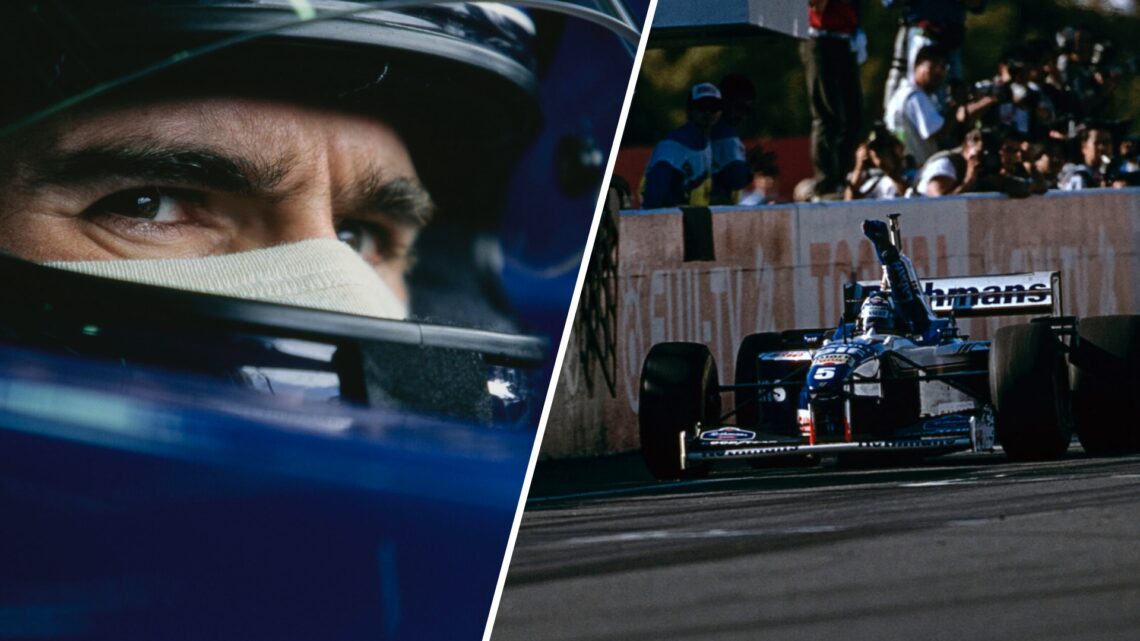


When Damon Hill won the 1996 F1 World Championship, it was a weight that had been taken off his shoulders.
Since he’d turned his first wheel in the sport, comparisons were made to his multiple title-winning father, Graham Hill, who had mastered the streets of Monaco and become a legend in his own right.
Following in the footsteps of a successful father is tricky in F1 because of the intense scrutiny, as was proved by Jacques Villeneuve, Mick Schumacher, Nico Rosberg.
Hill initially joined the F1 grid with the doomed Brabham team in 1992, but failed to qualify for six of the eight races he entered. It wasn’t until the 1993 season that Hill would get his chance with Williams, after Nigel Mansell got into a contract dispute with the team.
His role as test and reserve driver came in handy when they needed an experienced driver alongside Alain Prost to drive to the sophisticated Williams FW15, one of the first cars to feature active ride height.
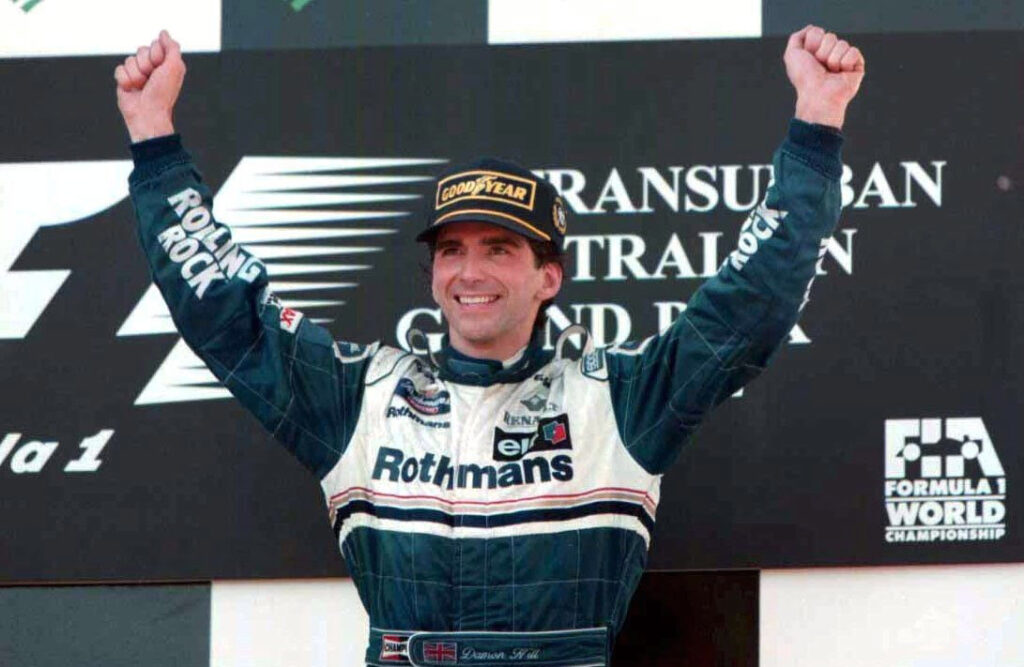
When Damon Hill won the 1996 world championship
It would take a couple of years and heartbreak at Williams before Hill was able to challenge for titles, with the 1994 season a particularly difficult year for the team due to the death of Ayrton Senna.
Hill suddenly found himself playing the same role as his father when Jim Clark died at Lotus in 1968, and was the driving force that bound the team together through difficult times.
The Briton would engage in a fierce rivalry with Michael Schumacher throughout the 1994 and 1995 seasons, before coming of age in 1996.
The car and driver combination of the FW18 and Hill were unstoppable, as he won four of the first five races of the season that year. Schumacher had switched to Ferrari by this point, meaning Hill’s nearest rival was teammate Villeneuve.
READ MORE: When Damon Hill set a unique Formula 1 record with his first win for Williams in 1993
Adrian Newey recalls Damon Hill title success ‘perfect way to give the finger’ to Williams management
Hill’s luck was more fortunate at key points during the season, but he would later learn that Williams would be dropping him in favour of Heinz-Harald Frentzen.
Discussing what happened in his book, How to Build a Car, then-Williams technical head Adrian Newey explained how it impacted Hill’s performances on track.
“It was now common knowledge that Damon was to be ousted. The shock of discovering that he was working his notice got to him, and he threw away his easy lead at Monza. At the penultimate race in Portugal, he came third to Jacques. And so to Japan, the last race of the season with Damon nine points ahead of Jacques. All he had to do was secure one point, and the championship was his,” wrote Newey.
“He just needed to finish in the point. A top-six place. I really wanted Damon to win now; I felt he thoroughly deserved it. He’d led the team out of the dark days of Imola and become a good friend in the process.
Villeneuve needed to win the race and hope that Hill didn’t score any points to clinch the championship, and in those days points only went down to sixth place.
“Sure enough, the race became Damon’s championship when, on Lap 37, the wheel nut came off Jacques’s car. It must have been a mistake in the pit stops, and it was a great shame that Jacques’s championship challenge ended with a car problem,” said Newey.
“But Damon was already on course to win the race, which he duly delivered. It was, for Damon, the perfect way to give the finger to Williams’ management: winning the race and bowing out as a world champion.”
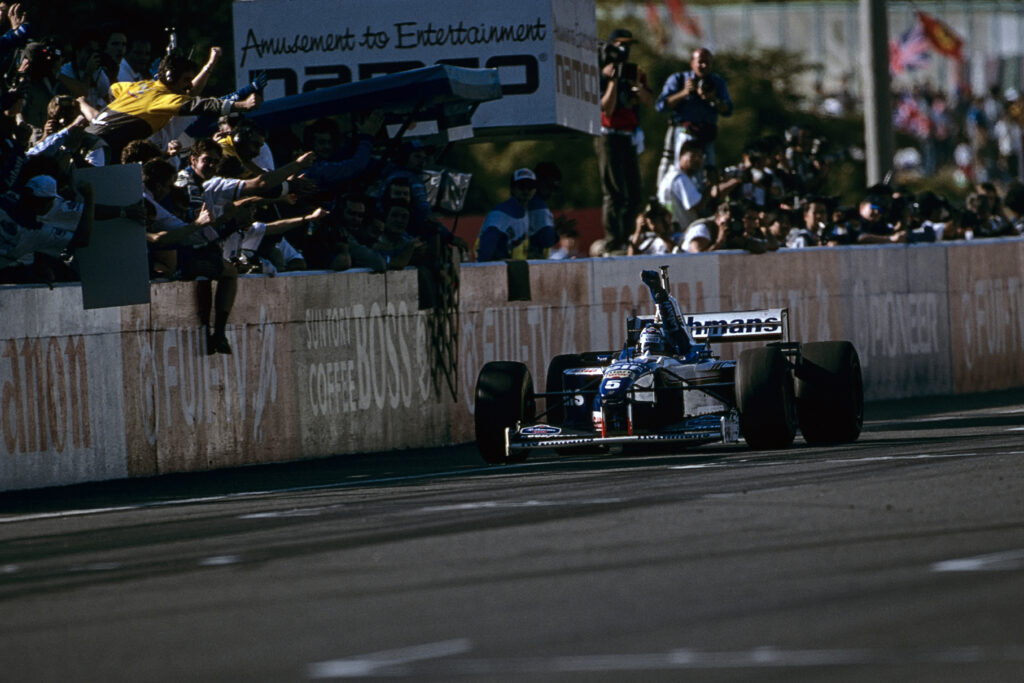
Damon Hill felt he was ‘too late’ making it to F1
It was history repeating itself at Williams with a British driver winning the title and then being ousted from the team the following season, but for Hill it was all too inevitable.
Discussing how it all unfolded on the BBC Chequered Flag podcast, the Briton explained that he felt he wasn’t in the same league as Schumacher or Senna.
“I hadn’t really proven I could challenge for a title in their mind. If you look at how long it took for me to get to F1, and that started out as a test driver, I only got it because Nigel Mansell went to America, and there was a seat available. So I’d never advertised myself as a guaranteed world champion, so I still had to prove myself,” said Hill.
“I proved to myself that I could be at the sharp end and beat Michael Schumacher. To beat Michael in the wet for a world title at Suzuka, meant I had something. But you have to look at the people like Lewis Hamilton, Schumacher, Max Verstappen and Senna. Was I one of them? Not really, I have to admit that. I was too late to the game.”
After his title success in Suzuka, Hill would only win one other race at the 1998 Belgian Grand Prix for Jordan before retiring at the end of the 1999 season.