

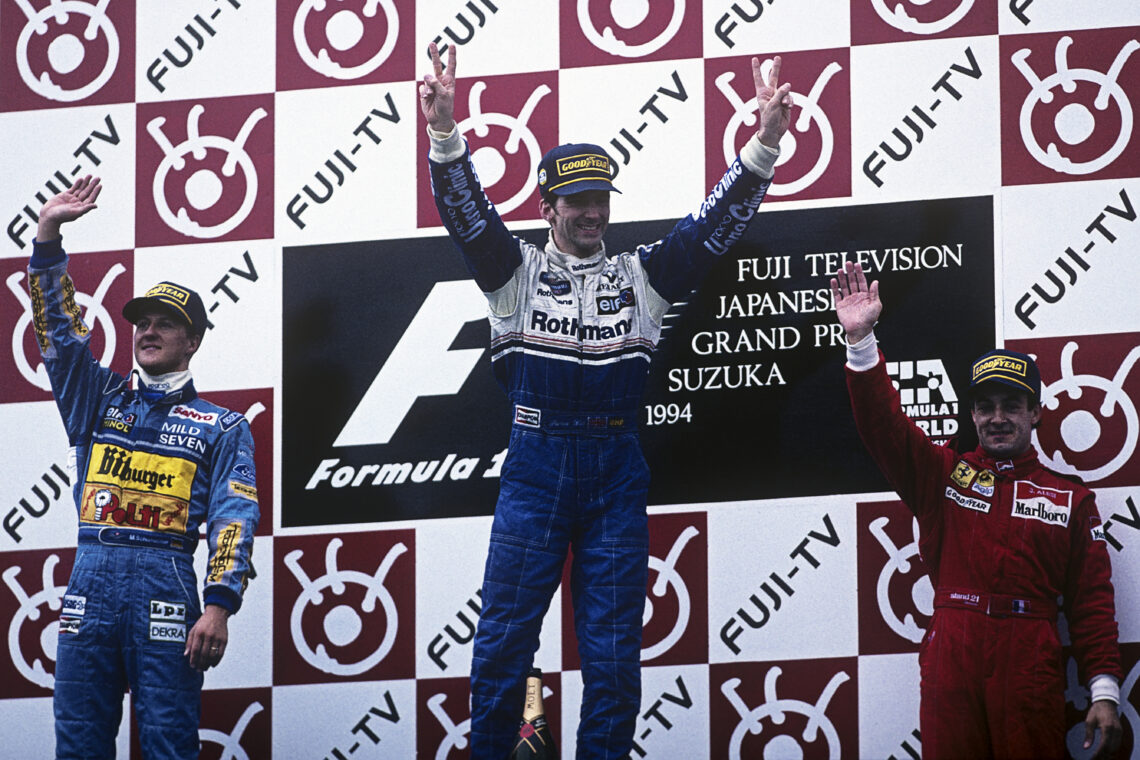


Damon Hill had a far from conventional Formula 1 career compared to many of the world champions that he competed against.
Unlike stars such as Michael Schumacher, Ayrton Senna and Alain Prost, Damon Hill hadn’t aspired to be a Formula 1 driver from a very young age.
He had no experience in karting and was far more keen on racing motorcycles than emulating his father and fellow F1 champion Graham Hill.
However, spells in British F3 and Formula 3000 eventually led Hill to make his F1 debut in 1992 with Brabham.
A full season as a Williams driver followed in 1993 after the sudden exit of Nigel Mansell, who refused to play second fiddle to new teammate Alain Prost.
Prost would go on to win his final championship that year, before quitting F1 himself with Senna signed as his replacement.
The death of the Brazilian was a heartbreaking event for all involved, and put added pressure on Hill to be the lead driver of one of Formula 1’s most recognisable teams.
He fought valiantly to stop Schumacher winning the title, with their collision at the final race in Adelaide the lasting memory of their fight that season.
However, Hill insists that the 1994 Japanese Grand Prix was the ‘greatest race ever’ of his career, and it’s clear to see why.
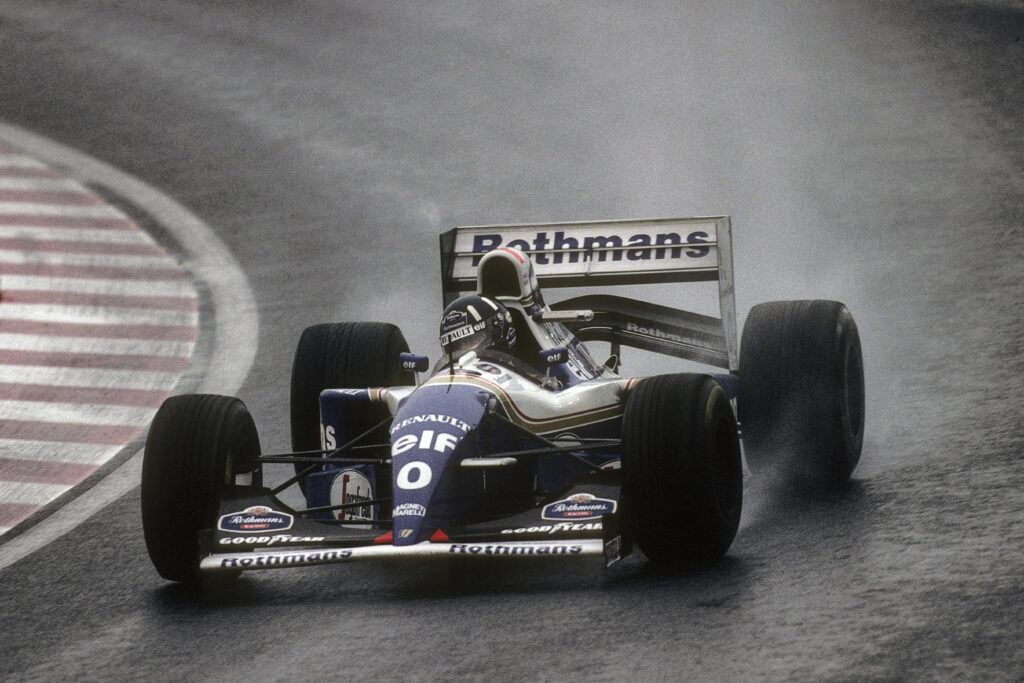
How Damon Hill won the 1994 Japanese Grand Prix ahead of rival Michael Schumacher
Hill was speaking about the race in a feature for Sky Sports and explained: “I was thrown in the deep end really after Imola and we lost Ayrton, I was thrown straight into this championship battle with Michael Schumacher.
“I had to really dig deep myself to find out whether or not I could beat this guy.
“One of the greatest races I ever had was at Suzuka in 1994, I had to beat Michael in torrential conditions.
“I still regard that as my greatest race ever. The fact that I raced and beat a guy like Michael Schumacher makes it mean even more to me.”
Writing in his book Watching His Wheels about the race, Hill recalled: “I couldn’t see anything.
“It was like having a garden hose turned on you. All I knew was, if I lost sight of the red light on the back of his Benetton, he’d be off into the distance.
“I hung on, and, for the first dozen laps, I witnessed the most incredible driving display I’ve ever seen in a racing car.
“I lost count of the number of times Michael went off the road, and yet he never lost a beat.
“I was driving on the edge of my ability, up here in the thin air with one of the best there has ever been. But, bit by bit, Michael was starting to get away.”
Schumacher opened up a 6.8-second gap over Hill before the race was red-flagged on lap 15.
For the final time in Formula 1 history, the race was run to aggregate times, meaning that when it eventually restarted, Schumacher controlled the pack behind the safety car, and racing began.
The time set from lap 16 onwards would then be added to the time from the first 15 laps to achieve the final result.
Hill didn’t need to overtake Schumacher, instead opting for a one-stop strategy, with Schumacher pitting twice.
| RANK | DRIVER | TEAM | TIME | POINTS |
| 1 | Damon Hill | Williams | 1:55:53.532 | 10 |
| 2 | Michael Schumacher | Benetton | +3.365 | 6 |
| 3 | Jean Alesi | Ferrari | +52.045 | 4 |
| 4 | Nigel Mansell | Williams | +56.074 | 3 |
| 5 | Eddie Irvine | Jordan | +1:42.107 | 2 |
| 6 | Heinz-Harald Frentzen | Sauber | +1:59.863 | 1 |
The 1996 world champion produced a lap of a lifetime to win the race, stating: “I was possessed. I watched my hands moving the wheel, completely free to do whatever they wanted in response to the car moving beneath me.
“I was just an observer of something phenomenal. I would never come close to driving like that again.”
Schumacher crossed the line 10.1 seconds behind Hill, meaning that the Williams driver won by 3.3 seconds, with Ferrari’s Jean Alesi completing the podium.
READ MORE: How a ‘stupendously brave’ F1 driver won the world championship despite winning only one Grand Prix
Why Damon Hill’s 1994 Japanese Grand Prix victory was so important
Hill’s victory wasn’t as dramatic as Vittorio Brambilla spinning across the line to win his only F1 race, but it was far more important in laying down a marker that he was a championship contender.
Schumacher described Hill as ‘really stupid’ a year later at the British Grand Prix after they got tangled up in an incident.
But at this point, it was clear that Hill threatened Schumacher’s supremacy.
| Grand Prix starts | 115 |
| Pole positions | 20 |
| Wins | 22 |
| Podiums | 42 |
| Fastest laps | 19 |
| Points | 360 |
| Championships | 1 (1996) |
Not only that, but his win at Suzuka was all Williams needed to be convinced that he was the man to lead the team going forward.
Nigel Mansell had briefly returned to replace David Coulthard following the death of Ayrton Senna, but the Brit was able to completely retire from F1 at the end of that campaign.
Hill would go on to achieve his only world championship in 1996 at Suzuka, inspiring the iconic, ‘And I’ve got to stop because I’ve got a lump in my throat,” commentary line from Murray Walker, signifying the importance of his victory to those who had closely followed his F1 career.