

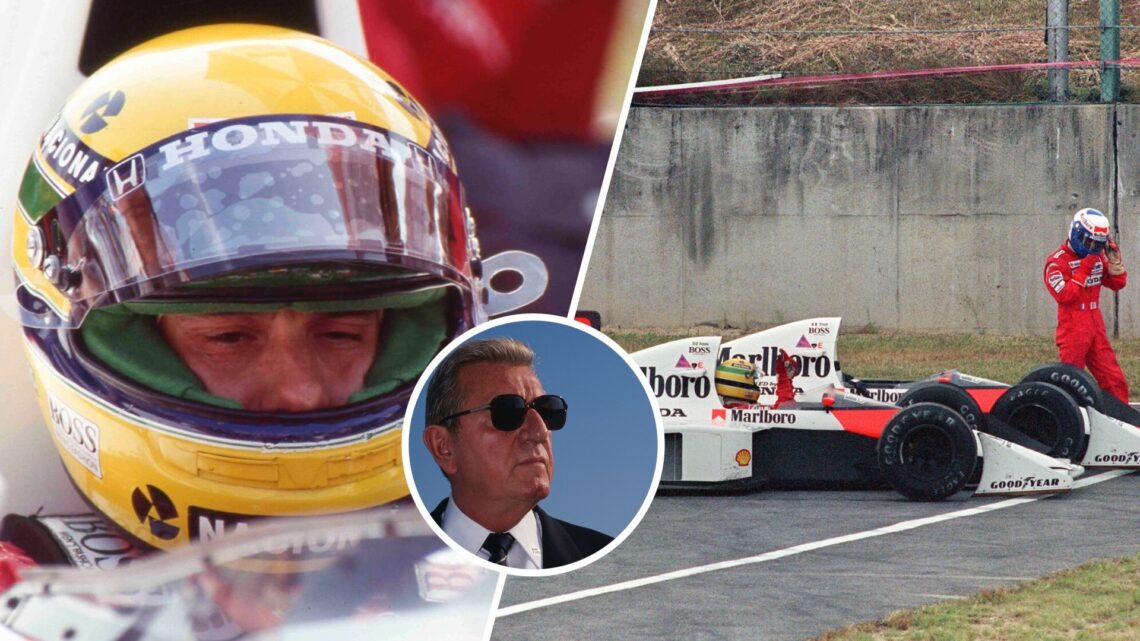


The outcome of the 1989 Japanese Grand Prix was one of the most controversial in Formula 1 history, when McLaren teammates Alain Prost and Ayrton Senna collided on track at Suzuka.
It would not be the last time the two title protagonists hit each other, but it might have very nearly spelled the end of Senna’s F1 career if one outcome was carried out in the aftermath.
Tensions were high enough when Senna and Prost arrived at the penultimate race of the season with 17 points between them, as the Brazilian was more than willing to show no mercy to his title rival.
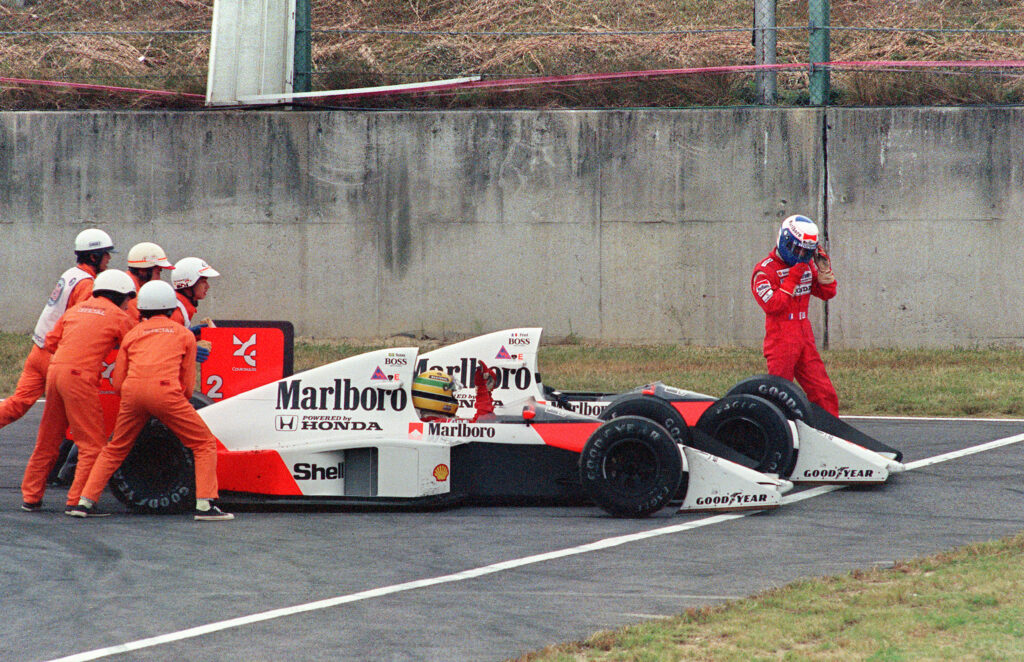
While Prost overtook Senna with ease at the start, the two would later collide at the final chicane, forcing both to skid into the escape road. With both cars stationary, it looked like they were out on the spot. Senna managed to bump start his McLaren and rejoin via the escape road, while Prost was forced to retire.
Senna was pushed by marshals and after a brief pit stop, went on to win the 1989 Japanese GP, except he would not have the chance to stand on the podium.
Ayrton Senna accuses FIA of favouritism after Japanese GP disqualification
Not long after the chequered flag fell, Senna would be disqualified for receiving outside assistance and cutting the chicane to rejoin the race. Although Senna had won on track, it handed the title to Prost.
A few days after the season ended, an outraged Senna would accuse FIA President Jean Marie Balestre and the FISA of interfering with the championship outcome to favour a French champion.
Balestre would fume, summoning Senna before the World Motorsports Council (WMSC) on 6th December, where he was told to retract his comments the following day. Senna stood his ground, but the WMSC would take further action.
They voted to suspend Senna’s 1990 superlicence unless he withdrew his allegations of race fixing. The decision would’ve prevented Senna from competing in the following season, and his name initially didn’t appear on the official entry list.
READ MORE: When Niki Lauda produced a stunning comeback drive at Zandvoort in 1985 to take final F1 win
How did Ayrton Senna avoid a ban in 1990?
Senna told the media that he “might not come back” after the season finale in Adelaide, and would remain silent on the matter throughout the winter break. McLaren later confirmed their entry for both cars for the 1990 season on 31st January – the deadline for teams to submit their entry list.
It also transpired that McLaren hadn’t paid the £75,000 fine for what happened at Suzuka. The team eventually paid it so they appeared on the entry list for 1990, but not both drivers.
Gerhard Berger was confirmed as their main driver, but there was a ‘TBA’ next to their second driver. The deadline date for superlicences was on February 15th and neither McLaren, FISA or Senna issued any update.
When the deadline passed, an ‘official and definite’ 1990 entry list was published with McLaren showing Berger and Jonathan Palmer, who was their official test driver. While it seemed like Palmer was getting his F1 shot at the defending champions, less than an hour later, another list was published with Senna replacing Palmer.
Senna had issued a statement with FISA claiming that he did not hear any proof of a pressure group of the President of FISA (Balestre) influencing the results. While it did not explicitly contain an apology, it was enough for Balestre, who allowed him to enter the 1990 season.
The Brazilian would later cause a stir in the weeks leading up to the first race of the season by issuing a statement claiming it was him who paid the £75,000 fine, which angered Balestre and led to him threatening to withhold his licence.
In the end, Senna took part in the season opener at Phoenix, Arizona, in the US and won the race for McLaren, while Prost left the team to join Ferrari.