

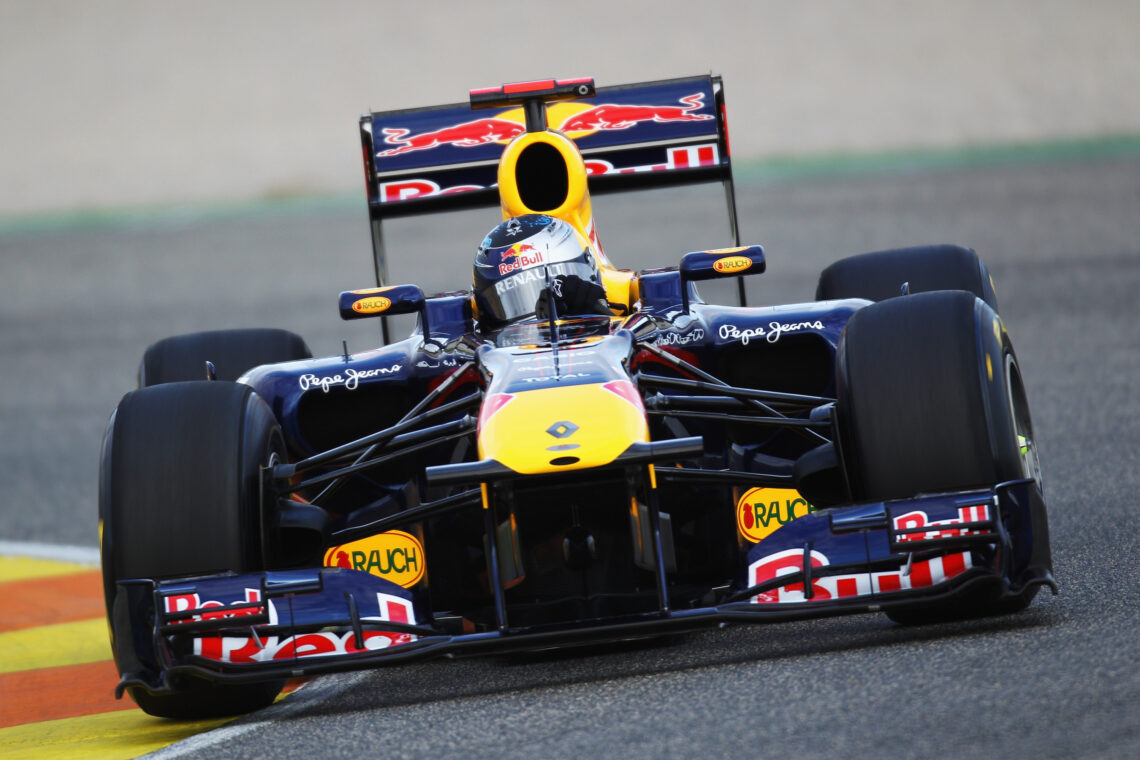


Sebastian Vettel was unstoppable in 2011. Red Bull’s RB7 was a masterpiece penned by Adrian Newey, but it generated a lot of controversy between rival teams.
Red Bull missed out on the title in 2009 during the big regulation reset, thanks to the double diffuser on the Brawn GP. Then in 2010, Vettel managed to outscore three other drivers to win the title after Mark Webber suffered a big title blow at the race in Korea.
Keen to maintain their advantage into 2011, Red Bull would lead the pack with a design known as the ‘blown diffuser’ on the RB7, a device that used an ingenious solution in the exhaust manifold devised from World War Two bombers.
The blown diffuser concept gave Red Bull an extra half a second per lap, as it utilised the pulse of the V8 engine and the air blown out of the exhaust to generate more downforce.
Every other F1 team had come up with their own concepts, but Red Bull’s was far more advanced and used a system that allowed the engine cylinders to fire when the driver was off throttle. This is where rival teams attempted to get it banned.
Rival F1 teams attempt to get Red Bull’s off-throttle blown diffuser banned
Nearly every other F1 team on the grid had a concept that was good to go in 2011, but Red Bull’s was two steps ahead because they managed to find a way to cleverly manipulate the engine maps.
Engine supplier Renault had developed an engine that ensured there was always some degree of airflow being expelled from the exhaust outlet. Red Bull would run the exhaust manifold towards the floor to effectively seal the airflow to the diffuser, generating extra downforce even when off-throttle.
The FIA initially banned off-throttle blown diffusers at the Spanish GP because it was deemed to be a movable aerodynamic part, as the concept uses moveable parts in the engine to manipulate aerodynamic grip.
When they removed it a day later, pending the outcome of a Technical Working Group meeting, several teams threatened to protest the race results. None of the Cosworth-powered teams including Williams, Hispania and Virgin, along with the Ferrari-powered teams Sauber and Toro Rosso could use the off-throttle system.
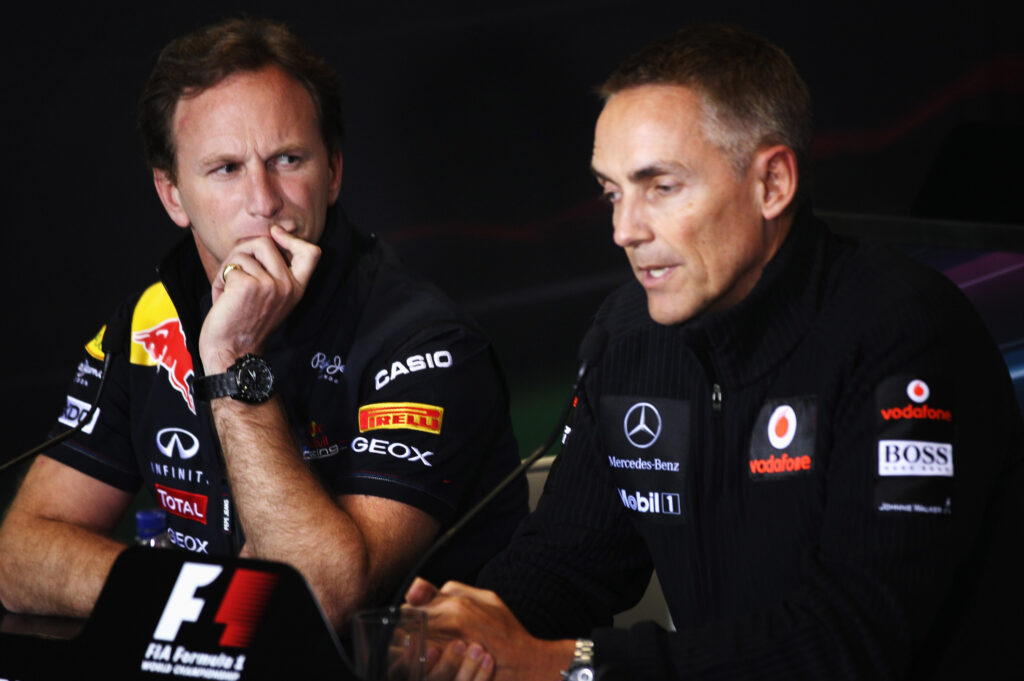
Christian Horner and Martin Whitmarsh erupt after FIA concession for Renault
The situation after the European GP enabled teams to make certain approved changes to the ECU, but engine maps could not be altered between qualifying and the race. Furthermore, all teams were limited to the amount of throttle power to 10% under braking, with Adrian Newey admitting that Red Bull had the most to lose from the ban because the RB7 was designed around the concept.
However, Renault was offered a concession when the FIA permitted them to run up to 50% of full throttle due to reliability concerns. Upon hearing, the Mercedes-powered teams would lodge a protest, which would involve a review of Renault’s exemptions.
Red Bull team principal Christian Horner would later respond to the protest, stating that Mercedes-powered cars had concessions to manage pressure in the crankcase of their engines. It led to a rather frosty exchange between Horner and McLaren team principal Martin Whitmarsh in the Friday press conference of the British GP weekend.
| Martin Whitmarsh | Christian Horner |
| Whitmarsh: “We’re talking about a very substantial performance benefit here.” | |
| Horner: “Why is it any more of a performance benefit than fired overrun? At the end of the day, Renault is allowed to fire overrun for reliability purposes but it can’t. If you can operate your engine in the same way as the Renault you’re welcome to do so. The secondary effect I think, it is wrong to suggest there is a benefit beyond that.” | |
| Whitmarsh: “Clearly if you’ve got, under braking, throttles opened 50% then it’s a reasonable benefit. There is a lot of gas going through and I would imagine a lot of engines will end up doing that, which wasn’t envisioned when we said we’re going to ban engine blowing.” | |
| Horner: “But where is the difference between firing on overrun and creating… So Mercedes engines aren’t firing on overrun?” | |
| Whitmarsh: “They’ve been constrained…. As you know….” | |
| Horner: “As have Renault.” | |
| Whitmarsh: “But providing the constraints are the same for everyone, but clearly, the fact that we are having this discussion it’s messy. I think the intention people believed was that we were going to stop the exhaust blowing when the driver didn’t have his foot on the throttle. I think that was the simple concept, but that concept has been deflected, and therefore it hasn’t been clear. The fact that these things were only coming out today is fairly extraordinary. These changes, by cold blowing, you’re getting 30 to 40 points of extra downforce just under braking and that’s quite an attractive thing isn’t it?” | |
| Horner: “But lets not make any mistake here, firing on overrun, the thrust that generates creates a bigger effect. Lets be absolutely clear about that.” | |
| Whitmarsh: “And that’s why it’s been largely contained. Those strategies are not permissible now. Well, it wasn’t when I came in here, maybe things have changed, and now we can do it. Maybe you know more about it than I do, Christian!” | |
| Horner: “Well, I’ve read the technical directive that said four-cylinder, firing on overrun was permissible for certain competitors and that I think includes your engines. As far as we’re concerned, Renault are allowed to use their parameters. Obviously, there was a significant advantage going to any Mercedes-powered team. As you can see, it’s a massively complex subject. I think the one thing Martin and I will agree on is that it should’ve been addressed at the end of the year, but here we are.” |
After growing dissatisfaction over the situation, the FIA moved to revert to the pre-European GP specification. However, neither Ferrari nor Sauber would sign the agreement until after the British GP took place.
This effectively meant they ran the engine maps under the limitations in the race, with Fernando Alonso going on to take his one and only victory that season. After a second meeting among the teams, it was agreed to scrap the ban for 2011 but implement something for 2012.
It allowed Red Bull to keep their advantage, with Vettel going on to win his second title in a row later in the season at the Japanese GP, with four races still to spare. He finished the year on 392 points compared to title rival Jenson Button’s 270 points.