




Ferrari was in decline at the start of the 1970s, as they became outclassed by the Cosworth DFV engines and the ingenuity of Lotus and Colin Chapman.
But after two difficult years in 1972 and 1973, the Maranello squad would establish itself as a title contender again as a result of changes made behind the scenes to their team structure.
One of the most significant was appointing Luca Di Montezemolo as their team manager, but there was also a quiet change made to their design team. Mauro Forghieri was made chief designer, and he created what was one of the most technologically advanced cars of the pre-turbo and ground effect era.
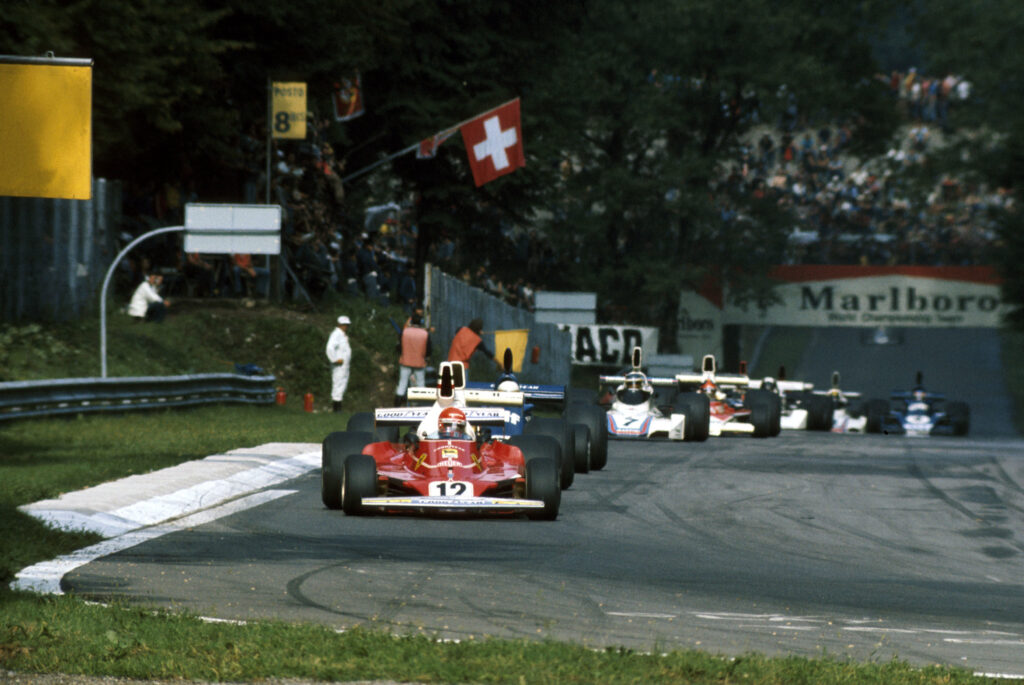
The Ferrari 312T proved to be more agile and maneuverable compared to its predecessors, and enabled Niki Lauda to take his first Formula 1 championship at Monza 50 years ago.
Ferrari’s technical revolution with 312T in 1975
Along with the team restructure, Ferrari decided to end its time and money-consuming sports car programme to focus on returning to title success in F1. Forghieri was brought over from their sports car programme and realised that the bodywork on an F1 car could be used to help create more downforce.
Most of the cars from the early 1970s had used the same 1960s design that prioritised lowering drag, but there was a realisation that more lap time could be gained by enhancing downforce that would be lost to drag.
Ferrari’s engine for the 312T was a technical marvel, with it utilising a flat-12 layout that produced 500bhp, beating the Cosworth DFV engine that most of their competitors had.
Used throughout the 1974 season, it was reused on the 312T in 1975 to help achieve the goal of enhancing the central mass. This was key to the next development made in 1975 with the help of Forghieri: the transverse gearbox.
Contrary to the usual design, this gearbox was mounted by 90 degrees to help bring the centre of mass forward and featured bevel gears that enabled the gearbox shaft to be arranged sideways, with final drive being via spur gears.
The concept was heavily tested at Ferrari’s Fiorano track by Lauda, but it would not make its debut until the fourth round of the 1975 season.
Niki Lauda clinches first world championship at Monza with Ferrari
The 312T proved to be an instant hit for Ferrari, comfortably being the fastest car of the season with Lauda at the wheel, who took five victories and won the Driver’s Championship over Emerson Fittipaldi.
Lauda won the title at Ferrari’s home track at Monza, with him later praising the impressive engineering of the 312T when speaking to Motorsport Magazine.
“It was a fantastic car. The ’74 car had given us a strong base, but this one had a better balance. It understeered less, and though it was more twitchy, I soon adjusted my driving style and had the feeling it would do exactly what I wanted it to,’ said Lauda.
“It was just better than everybody else’s car: better engine, chassis and gearbox. The engine was more powerful but heavier and used more fuel than a Cosworth, so you sometimes had to look after the tyres in the early laps.”
Much of this success could be attributed to Forghieri’s genius engineering solutions that made their way onto the 312T, although Lauda knew he had to keep him and the team focused on their main goal throughout the season.
“Forghieri was a genius but you needed to control him. I remember at Barcelona in practice, I came in and told him I had understeer. He said, ‘You’re taking the wrong lines’. I asked where, and he said, ‘Round the back of the circuit’ ‘How do you know?’ Because I have a friend out there who tells me.’ ‘Who’s your friend?’ Ah, it’s the lady friend of my doctor.’ I said, ‘Fix my f——- understeer.’ He did and I put it on pole,” said Lauda.
It was not only Lauda’s first title, but Ferrari’s first Constructors’ Championship in 11 years, with the team going on to win the following two in 1976 and 1977. Ferrari’s mid-1970s dominance would be brought to an end by the Lotus 78, the first F1 car that used ground effects.