

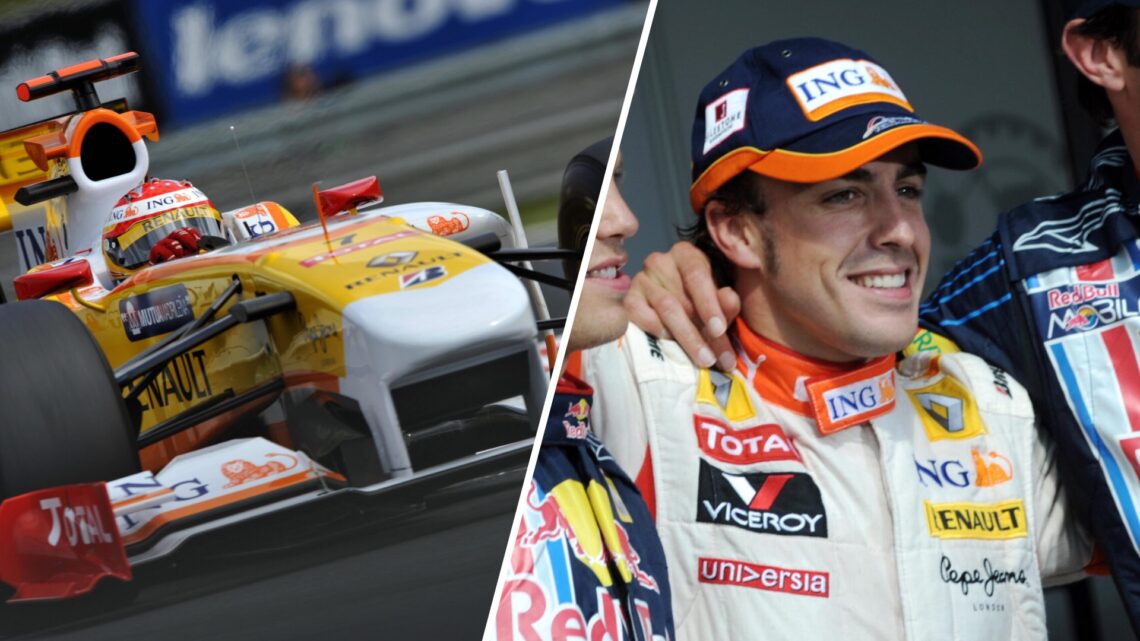


There are some tracks in Formula 1 where qualifying is everything, and the Hungaroring is one of those circuits where it pays to start from pole.
This is because of the tight nature of the track, often being compared to Monaco but without the walls. In reality, it is a circuit that rewards downforce and driver skill in the tight and twisty final sector.
The 2009 season was a year that had a big change in the regulations for the teams, with the cars adopting wider front wings and narrower rear wings in a bid to improve overtaking.
Fernando Alonso had last won a race at the controversial 2008 Singapore Grand Prix, but Renault’s car proved to be uncompetitive at the start of 2009 compared to the likes of Brawn, Toyota, Red Bull and Williams.
The Spaniard had mixed results throughout the season, but at the Hungarian GP, he managed to string together a lap that was good enough for pole, although he didn’t realise it at the time.
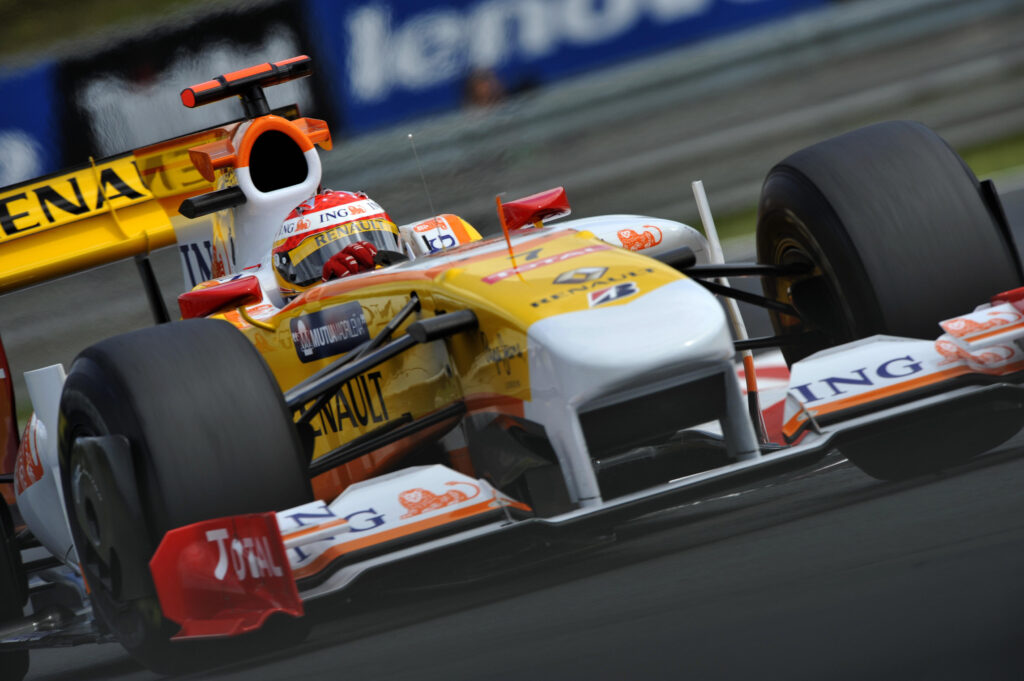
Fernando Alonso left confused after timing error at 2009 Hungarian Grand Prix
Qualifying was already turning into a mixed bag of results, with Nico Rosberg topping the timesheet in Q1 while both BMW drivers and the Force India of Giancarlo Fisichella dropped out.
After a brief scare in Q2, Alonso made it through to the final part of qualifying and was on course to set pole in his Renault before the official timing system malfunctioned.
It led to mass confusion among the drivers as they all parked in Parc Ferme, with Alonso getting out and questioning them individually. He approached Button, who parked directly alongside him first.
Alonso: “Which time you do?”
Button: “22.5”
Alonso: “Me 21.5”
Button: “F—- hell!”
Alonso: “But I don’t know which position I am…”
He went to more drivers in an attempt to figure out who had the quickest time, before comically asking the cameraman who was filming: “Who is on pole?”
With the cameraman unable to oblige, he turned to his old McLaren teammate Lewis Hamilton for answers when he got out of his car.
Alonso [to Hamilton]: “Which time did you do?”
Hamilton: “21.7”
Alonso: “I’m 21.5 – you know the position?”
Hamilton: “No.”
With all the drivers in the FIA weightbridge, the technical delegate Jo Bauer, told them: “Unfortunately, you need to all wait. We don’t know who is where…”
It turned out Alonso was on pole, with the Spaniard describing how it became a “really stressful” session because of how close he was to dropping out.
“This was a really stressful qualifying. There was a yellow flag towards the end of Q1 and, at that stage, I was 15th fastest and in danger of not making it [among the fastest 15] to Q2.
“When the track was clear, I had just one lap to do a time without making mistakes and I managed it. Then, at the end, the timing was not working. I asked other drivers what time they had done in order to get a reference and when everyone was saying times which were slower than mine, I started to get excited.”
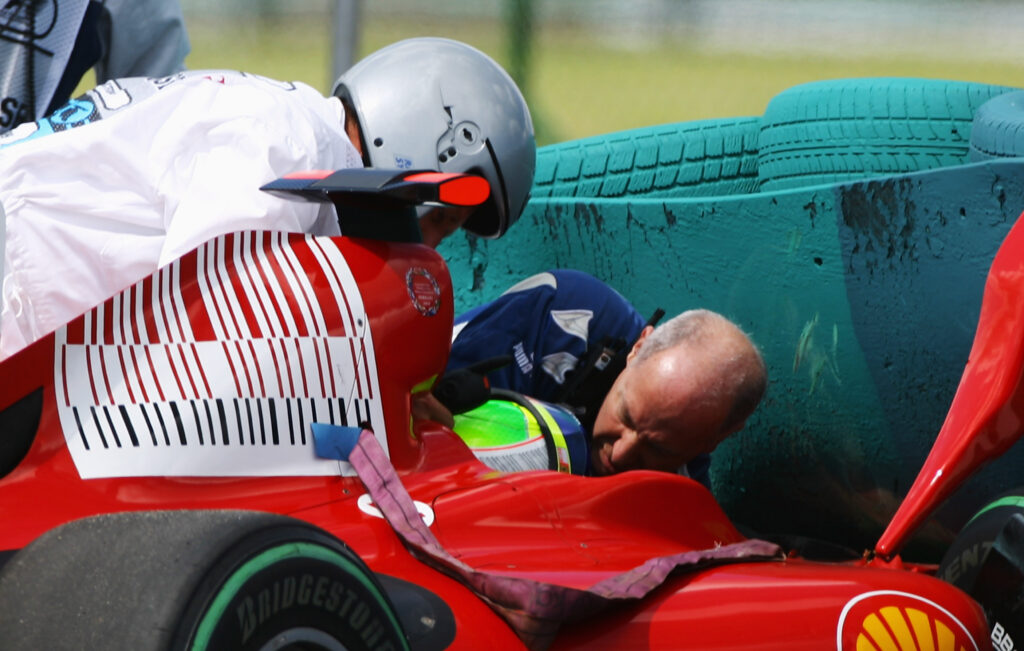
Felipe Massa incident overshadows 2009 Hungary race
It was a bizarre end to what was already a difficult qualifying session, following a serious accident with Ferrari’s Felipe Massa.
The Brazilian, who was sixth fastest in Q2, was struck on the head by a spring from the Brawn GP of Rubens Barrichello, knocking him unconscious.
With both of his feet on the accelerator and brake, in a bid to disengage the engine and slow down, Massa impacted with the adjacent barrier to Turn 4 at 62mph. When the car embedded itself into the barrier, the throttle was still engaged and bouncing off the rev limiter.
Massa was extricated from the car and deemed to have suffered a head cut, bone damage to his skull and a concussion. He would miss the remainder of the season before making a comeback in 2010.
The accident came just days after Henry Surtees lost his life in a Formula Two race at Brands Hatch after a wheel hit him on the head at speed.
Both incidents led to research into frontal cockpit protection devices, which in turn led to the Halo cockpit safety device used in F1 and feeder championships today.